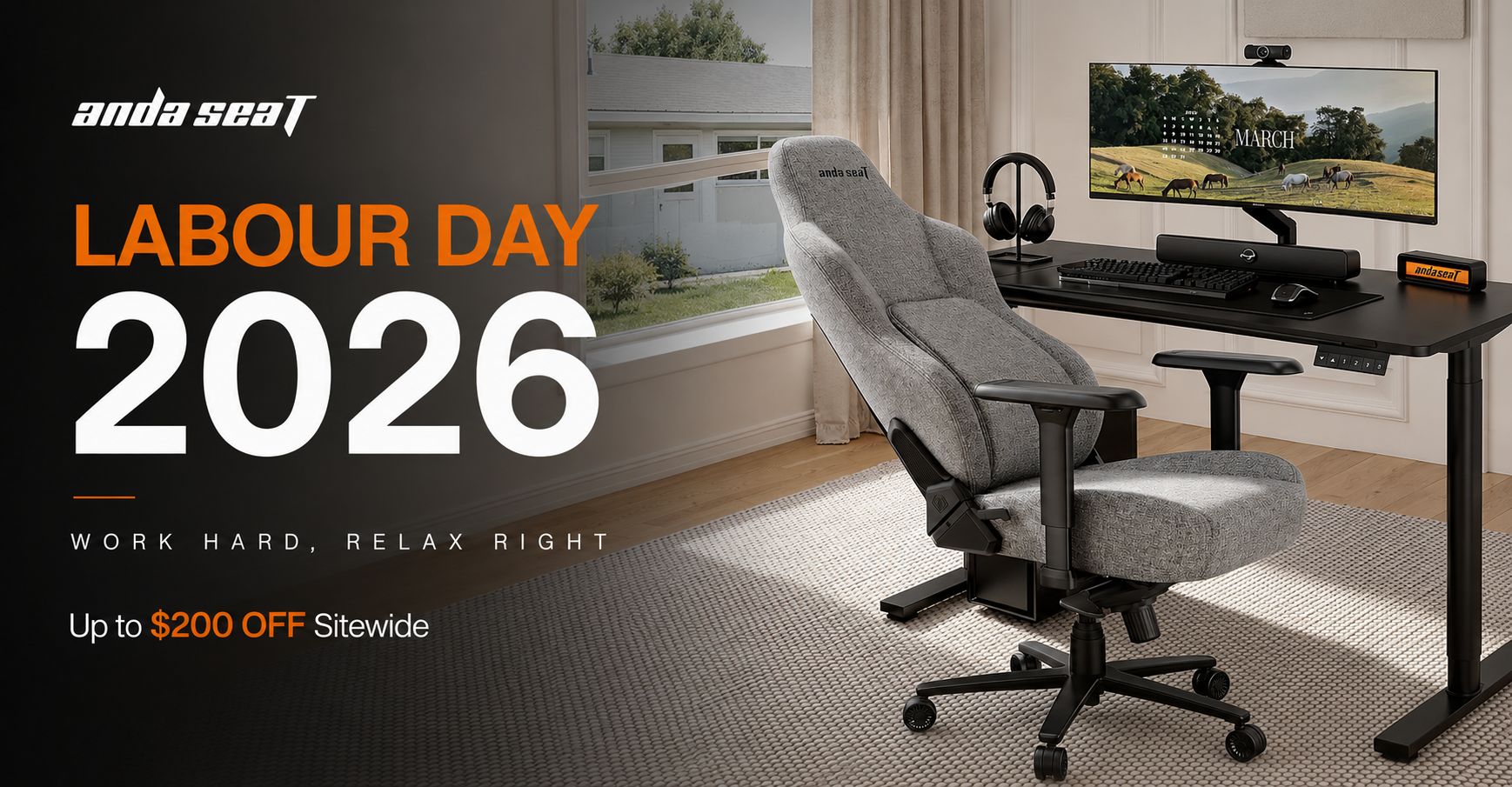
AndaSeat Labor Day Campaign Connects Phantom 4 Series With a Changing Approach to Seated Work and Recovery
SPOKANE, WA, UNITED STATES, September 4, 2026 /EINPresswire.com/ — 2026 Labor Day, AndaSeat is placing particular focus on the Phantom 4 Series as new workplace research draws attention to a question that sits outside conventional chair marketing: not simply how people sit while working, but how they recover from work and return to the workstation afterward.
On August 7, the University of Queensland reported new research examining how employees manage energy during the workday. The study used heart-rate monitors and short surveys across more than 600 hours of work and identified five common energy-management patterns. Employees who combined work organization with microbreaks — such as short walks, stretching or brief social interaction — reported the highest levels of energy, motivation and sense of mastery. Yet this combined approach appeared in only 6% of the work hours studied.
The findings do not evaluate furniture or AndaSeat products. They instead highlight a broader change in the workplace discussion: effective computer work may depend not only on the equipment used while working, but also on whether workers interrupt long periods of continuous activity.
NIOSH reinforced that point in updated office guidance published in July 2026. The agency advises that workers should avoid sitting or standing for too long and notes that short breaks every hour can help reduce discomfort during computer work.
For seating design, that raises a different question: if workers are encouraged to leave the chair more often, should an ergonomic chair be designed around uninterrupted sitting, or around repeatedly leaving and returning?
AndaSeat is positioning the Phantom 4 Series around the second model.
A Better Chair Should Not Be an Argument for Sitting Longer
The idea of a premium chair is often linked to endurance: longer work sessions, longer gaming sessions and fewer interruptions.
Current occupational guidance suggests a more cautious interpretation.
NIOSH states that ergonomic equipment is only one part of a healthy office environment and specifically identifies task design, breaks, working pace and equipment configuration as related factors.
A 2026 randomized controlled trial published in BMC Public Health provides another example of why interruption itself matters. Eighty-six sedentary office workers were assigned either to usual behavior or to three-minute micro-exercise breaks every hour during the workday. Over 12 weeks, the intervention group accumulated more light activity and reduced sedentary time by approximately 42 minutes per day. The researchers also reported improvements in several measured metabolic indicators.
That study evaluated a specific activity intervention in a defined population. It does not establish one universal break schedule, nor does it suggest that a chair can reproduce the effects of physical activity.
The relevant design lesson is more limited: a chair should work within a day that includes movement away from the chair, rather than assuming the user remains seated continuously.
Dynamic Lumbar Support Addresses the “Return-to-Chair” Moment
The Phantom 4 Series centers on AndaSeat’s dynamic auto-tracking lumbar mechanism.
The lumbar section can be extended across 15 locking positions within a 0–95 mm range. Once extended, the structure can swivel approximately 5 degrees to either side and tilt 25 degrees forward or backward as the user shifts against the backrest.
This movement becomes relevant when sitting is understood as a sequence of separate periods rather than one uninterrupted block.
A worker may stand for a short walk, refill water, speak with a colleague or complete another task away from the desk. When returning, the body may not settle into precisely the same contact position as before.
A static lumbar cushion can remain in one location unless it is manually repositioned. Phantom 4 instead provides a degree of movement around the position initially selected by the user.
This does not mean the chair automatically establishes an ergonomically correct posture after every break. It means the lower-back contact point has room to respond when the person settles slightly differently into the chair.
The concept is therefore less about “holding the perfect position” and more about reducing the need for support to depend on one exact seated alignment.
Recline and Rocking Are Seated Transitions, Not Break Replacements
Both Phantom 4 models provide recline up to 135 degrees and approximately 15 degrees of rocking movement.
These functions serve a different role from an actual microbreak.
A worker who reclines while remaining at the computer is still seated. Rocking within the chair is not equivalent to walking, stretching or leaving the workstation.
The distinction matters because ergonomic marketing can otherwise blur “movement in a chair” with “breaking up sedentary time.”
Phantom 4 uses recline and rocking for transitions that occur during seated periods: moving from focused typing to reading, reviewing material or a more relaxed screen-based task.
Phantom 4 Pro adds a tilt-lock function, allowing the user to establish a firmer backrest state when desired. The standard Phantom 4 uses a butterfly tilt mechanism with adjustable rocking tension.
In both cases, the chair supports more than one seated state, while genuine breaks remain a separate part of workday recovery.
Different Arm and Head Support Reflect Different Levels of Control
The Phantom 4 Series separates its two models through peripheral adjustment rather than through the central lumbar mechanism.
Phantom 4 Pro uses 3D 360-degree rotating armrests, with approximately 6 cm of forward-and-back movement and 7 cm of height adjustment. The standard Phantom 4 uses 2D armrests providing forward-and-back and vertical adjustment. Both are built around iron columns and locking structures intended to maintain the selected support position.
The Pro model also uses a magnetic memory-foam head pillow with a cooling layer and approximately 20 cm of vertical placement range. Phantom 4 uses an elastic-strap memory-foam pillow that can be moved vertically along the upper backrest.
These differences provide two levels of setup complexity.
Users who frequently change arm and head position may prefer the Pro configuration, while those seeking a more straightforward control system retain the same central dynamic lumbar concept in the standard model.
The Seat Provides the Stable Layer Beneath a Moving Backrest
Phantom 4 uses a 55 kg/m³ cold-cure foam seat across the series.
This gives the moving lumbar structure a relatively stable base beneath the pelvis and thighs.
That distinction is important because dynamic support does not mean every part of the chair should move simultaneously. Some contact areas need to remain predictable while others respond to changes in body position.
The chair therefore combines a molded seat foundation with a lumbar mechanism capable of limited multi-directional movement.
Leather and linen options allow users to select different surface characteristics, while magnetic side covers provide access around the backrest connection area for assembly and maintenance.
Labor Day Brings Recovery Back Into the Definition of Work
Labor Day falls on Monday, September 7 in 2026.
The timing gives AndaSeat an opportunity to frame workplace furniture around something broader than continuous productivity.
The University of Queensland’s August research suggests that workers who deliberately combine short recovery activities with work-management strategies may experience higher energy and motivation, while also showing that relatively few workers regularly use that combination.
NIOSH similarly identifies short breaks as part of a better-designed computer workday.
Phantom 4 cannot create those breaks, determine their ideal frequency or replace movement away from the workstation.
Its role begins when the worker sits down again.
The dynamic lumbar can respond to small changes in back position. Recline and rocking allow multiple seated states. Adjustable armrests and head support allow peripheral contact points to be reconsidered when the task changes.
In that sense, the Phantom 4 Series reflects a different definition of ergonomic seating: not a chair designed to keep the user seated indefinitely, but one designed to remain adaptable across repeated periods of sitting, movement and return.
About AndaSeat
Founded in 2007, AndaSeat develops ergonomic seating and workspace products for gaming, professional and home environments. Its portfolio includes ergonomic chairs, standing desks, monitor arms and related workspace accessories. The company develops products around adjustable support, structural engineering, material design and the changing ways people work, play and use computer-based spaces.
AndaSeat Marketing
AndaSeat
email us here
Visit us on social media:
LinkedIn
Instagram
Facebook
YouTube
TikTok
X
Legal Disclaimer:
EIN Presswire provides this news content “as is” without warranty of any kind. We do not accept any responsibility or liability
for the accuracy, content, images, videos, licenses, completeness, legality, or reliability of the information contained in this
article. If you have any complaints or copyright issues related to this article, kindly contact the author above.

Media gallery