
Key Takeaways
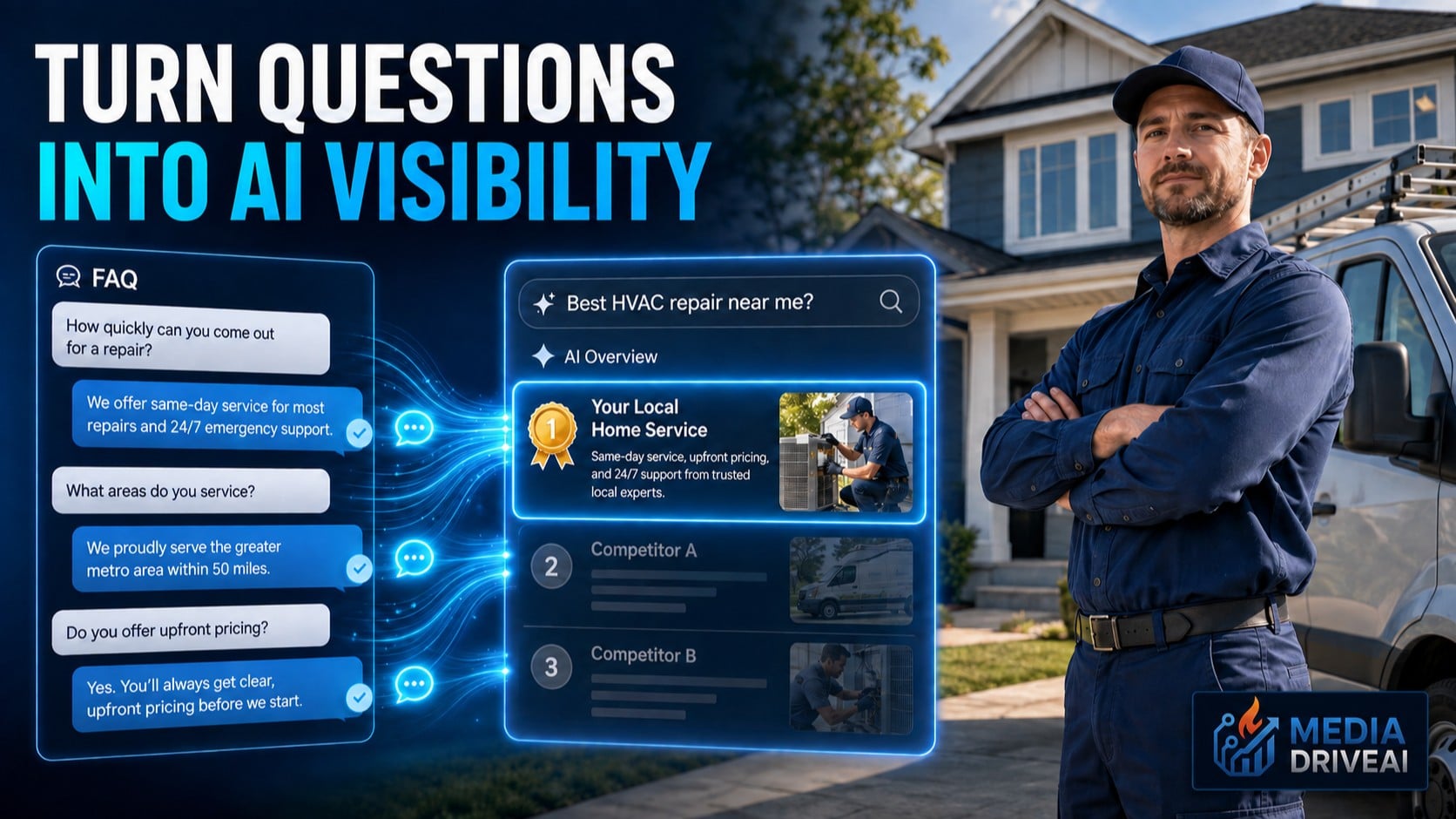
- Conversational FAQ pages help home service businesses show up in AI-driven search by turning real customer questions into clear, locally specific answers AI systems can quote
- Home service companies gain an edge when FAQ content covers actual decision points instead of the thin, generic service pages most competitors publish
- Placing a direct answer in the first sentence, followed by causes and next steps, makes content far easier for AI systems to extract and cite
- Google is phasing out the FAQ rich-result feature for ordinary businesses starting May 7, 2026, shifting the real goal toward answer quality rather than schema tricks
- Building separate FAQ hubs for each service, instead of one giant catch-all page, tends to perform better for both customers and AI search tools
Homeowners no longer type broken phrases into a search bar and scroll through ten blue links. They ask a question the way they’d ask a neighbor: “Why does my furnace smell weird when I turn it on?” or “Can someone fix a burst pipe tonight?” AI-driven search tools like Google AI Overviews, ChatGPT Search, and Perplexity are built to answer those exact questions, and they pull answers from wherever the clearest, most trustworthy content lives.
AI Now Decides Who Gets Recommended
That shift matters because AI systems are no longer just organizing links, they’re deciding which business gets named out loud. Instead of returning a list of nearby plumbers, an AI assistant might recommend one specific company by name, based on how clearly that company answered a related question somewhere online. Some industry observers point out that AI-assisted search is already shaping a meaningful share of local service decisions, with that trend continuing to build through 2026.
For home service pros, this changes the competitive playing field. Ranking on page one used to be the finish line. Now, the finish line is being the source an AI system chooses to quote. The team at MediaDrive AI points to conversational FAQ pages as one of the most reliable ways for local service businesses to earn that spot.
Why Conversational FAQs Win in AI Search
Conversational FAQs work because they mirror exactly how AI systems are built to search: pull a focused, well-supported answer to a specific question, then present it to the user.
Topical Coverage Beats Thin Service Pages
Most competitors still publish thin service pages: a headline like “Plumber in Denver,” a phone number, and a few sentences of broad marketing language. That kind of page rarely answers anything specific enough for an AI system to use.
A well-built FAQ hub does the opposite. It covers real decision points, things like why a water heater might leak from the bottom, whether a burst pipe can be fixed the same day, or what drain cleaning typically costs in a specific area. Those are the exact questions homeowners already have running through their minds, and covering them thoroughly signals real operational expertise rather than generic advertising.
Standalone Answers AI Systems Can Quote
AI systems parse content at the passage level, looking for a focused chunk of text that fully answers one specific question. That means each FAQ answer needs to stand on its own, without requiring the reader to scroll up for context.
Microsoft’s own guidance on AI search inclusion recommends keeping traditional SEO fundamentals in place while adding clear headings, modular content, and concise, self-contained answers in Q&A format. A vague paragraph that mixes pricing, safety, and scheduling into one blob is much harder for an AI system to extract cleanly than a tightly focused answer to a single question.
Writing Questions Homeowners Actually Ask
Getting the format right matters, but the questions themselves matter more. Conversational phrasing means asking a question exactly the way a real homeowner would say it out loud, without casual filler dragging down the clarity.
The Direct-Answer-First Response Pattern
A strong FAQ answer follows a simple pattern. Answer the question immediately in the first sentence, ideally under about 45 words. Then explain the likely causes or variables involved. Follow that with what the homeowner can safely do right now, and when it’s time to call a professional. Where genuinely relevant, add local context, then link to the matching service or booking page.
Here’s an example that follows this pattern:
“A brief dusty smell during the first heating cycle of the season is often normal, because dust has collected on internal components. Turn the system off and call an HVAC technician if the smell is persistent, smells like burning plastic or electrical wiring, or comes with smoke, unusual noise, or repeated breaker trips.”
That kind of answer resolves the question, separates normal from unsafe conditions, and gives a clear line for when to call for help.
Mining Real Customer Conversations for Topics
The strongest FAQ topics rarely come from keyword tools. They come from actual customer interactions: recorded phone calls, live-chat logs, estimate forms, dispatcher notes, technician objections at the job site, recurring themes in reviews, and query data from Search Console.
When five different homeowners ask, “Why does my sump pump keep running after it stops raining?”, that recurring, specific question is a far better FAQ candidate than a broad phrase like “best plumber near me.”
Structuring FAQ Hubs for Maximum Reach
How the FAQ content gets organized on the site matters almost as much as what it says.
Service-Specific Hubs Beat One Giant Page
For home service businesses, one massive catch-all FAQ page tends to underperform a distributed approach. The most relevant questions belong directly on the service page where the customer is deciding whether to book, while a searchable central hub can handle broader questions.
Building dedicated FAQ hubs for each service vertical, such as an emergency plumbing FAQ, a water quality and filtration FAQ, or an EV charger installation FAQ, keeps each set of answers focused and easier for AI systems to match against a specific prompt.
Adding Local Specificity That Actually Matters
AI search tools weigh hyper-local relevance heavily, so embedding real geographic detail helps content stand apart from generic national advice. That might mean explaining how sub-zero cold snaps affect heat pump efficiency at higher elevations, how hard local water interacts with copper piping versus PEX, or whether a specific city requires a permit for a 200-amp electrical panel upgrade.
The goal is to avoid cloning the same FAQ across a dozen city pages with only the city name swapped. A local page should include something that would actually change a homeowner’s decision, like typical seasonal problems, verified permit rules, or common housing stock in that specific area.
Structured Data’s Shrinking Role in Rankings
Schema markup still helps machines interpret a page correctly, but its influence on visibility has narrowed. Google has limited FAQ rich results to well-known, authoritative government and health sites, and its update notice confirms the FAQ rich-result feature will stop appearing in Google Search for ordinary businesses starting May 7, 2026.
For most home service companies, that means FAQPage JSON-LD markup should be treated as a way to clarify meaning for search systems, not as a shortcut to a special search result. Google’s structured-data guidance is clear that markup must accurately reflect visible page content, stay current, and avoid promotional or hidden claims. Adding schema correctly remains worthwhile as a supporting piece of the overall strategy, rather than a strategy on its own.
Answer Quality Now Determines Search Visibility
Across every section, one conclusion stands out: answer quality now decides who gets found and recommended, more than keyword density or schema tricks ever could. AI systems reward pages that answer real questions clearly, back up claims with specific detail, and organize information the way a homeowner’s brain actually works through a problem.
Common mistakes worth avoiding include publishing generic questions no customer actually asks, writing answers that read like advertisements, duplicating near-identical FAQs across dozens of city pages, and making universal pricing or warranty promises that don’t hold up once site conditions vary. A public FAQ page that reads like the best conversation between a dispatcher and a homeowner, calm, specific, and accurate, tends to earn trust from both readers and the AI systems summarizing them.
For home service pros ready to turn everyday customer questions into a source of steady, AI-visible traffic, building out conversational FAQ hubs for each core service is a practical place to start.
MediaDrive AI
bill@mediadrive.ai
+1-719-427-5511
8660 Dry Needle Place
Colorado Springs
CO
80908
United States


