
Brain Aneurysm Foundation Announces its 2026 Research Grant Recipients
PR Newswire
HANOVER, Mass., Aug. 4, 2026
Celebrating 20 Years of Grantmaking, BAF Awards a Record $650,000 to Support 18 Projects in Genetics, Artificial Intelligence, Diagnostics and New Treatment Strategies
HANOVER, Mass., Aug. 4, 2026 /PRNewswire/ — The Brain Aneurysm Foundation (BAF), the leading advocacy organization supporting education, research and policy to transform the treatment of brain aneurysms, today announced the recipients of its 2026 research grants. This year, $650,000 in funds will support 18 projects aimed at deepening the understanding of how brain aneurysms form and rupture and advancing new approaches to detection, risk assessment and treatment.
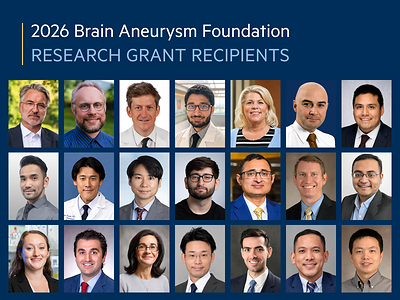
The investigators will be recognized at BAF’s 20th Annual Research Grant Symposium, to be held September 17, 2026, in Louisville, Kentucky. The symposium will include a morning scientific session and an evening awards dinner honoring the grant recipients.
Since launching its research grant program in 2007, BAF has invested more than $7 million in brain aneurysm research. BAF’s early-stage grants have helped researchers generate preliminary data, advance technologies and diagnostics, launch clinical studies and, in some cases, contribute to the formation of new companies.
The 2026 research portfolio spans the full arc of brain aneurysm science from genetic studies of familial disease and artificial intelligence tools for rupture prediction to imaging and blood-based biomarkers and therapeutic strategies designed to prevent or limit the devastating effects of aneurysmal subarachnoid hemorrhage.
“Scientific opportunity in brain aneurysm research is accelerating, but access to funding has not kept pace,” said Christine Buckley, executive director of BAF. “We received more applications this year than ever before, including many ambitious projects that need early evidence before they can compete for larger federal awards. BAF helps bridge that critical gap, giving researchers the resources to test bold ideas, build the data needed to attract additional support and move the most promising discoveries closer to patients.”
The need for greater investment remains substantial. An estimated 6.8 million Americans, approximately one in 50, have an unruptured brain aneurysm, while the federal government spends only $3.02 annually on brain aneurysm research for each person affected. Approximately 30,000 ruptures occur in the United States each year; about half are fatal, and roughly two-thirds of survivors experience permanent neurological deficits.
“BAF’s sustained support has brought us closer to a blood-based biomarker that could help identify which brain aneurysms are most likely to become dangerous,” said Kerry Poppenberg, PhD, of the University at Buffalo. “The ability to recognize risk before a rupture could give physicians and patients greater clarity, and more time, to make informed care decisions. Moving from a promising signature to a clinically useful test takes years of rigorous work, and that progress depends on consistent funding.”
A unique aspect of the symposium is the opportunity for funders to meet the researchers, learn about their groundbreaking projects, and see firsthand the impact of their support on advancing brain aneurysm research. In addition to funding research, BAF works year-round to improve outcomes through education, advocacy and support. The Foundation helps patients, families and caregivers navigate diagnosis and recovery; educates the public and health professionals about warning signs and the risk of misdiagnosis; and advances policies intended to strengthen research, awareness and care.
2026 BAF Research Award Recipients
Steffen-Sebastian Bolz, MD, PhD, and Darcy Lidington, PhD, University of Toronto —
Targeting Prostaglandin D2 Synthase as a Therapeutic Intervention for Subarachnoid Hemorrhage
Karol Budohoski, MD, PhD, FRCS, and Sri Veeturi, PhD, University of Utah Health — Phenotyping the Endothelial Response to Cerebral Ischemia in an Aneurysmal Subarachnoid Hemorrhage Model
Elizabeth Crago, PhD, MSN, RN, CEN, FCCM, University of Pittsburgh — The RESTORE-Symptoms Study: Hormonal and Inflammatory Correlates of Symptom Burden After Aneurysmal Subarachnoid Hemorrhage
William Gibson, MD, PhD, BC Children’s Hospital Research Institute, University of British Columbia — Long-Read Whole Genome Sequencing in Familial Intracranial Aneurysms
Andres Gudino, MD, University of Iowa — Biologically Validated Imaging Biomarkers for Noninvasive Assessment of Intracranial Aneurysm Wall Instability
Koji Hosaka, PhD, University of Florida, Gainesville — Enhancing Neurolysin-Mediated Neuroprotection After Subarachnoid Hemorrhage Using Pyridine Piperazine Derivatives
Naoki Kaneko, MD, PhD, University of California, Los Angeles — Hemodynamic Optimization of a Fenestratable Membrane Flow Diverter for Complex Giant Brain Aneurysms
Hiroki Kobayashi, MD, PhD, Barrow Neurological Institute — Role of Periostin-Expressing Activated Fibroblasts in Intracranial Aneurysm Development
Christian Lopez Blanco, BS, University of Alabama at Birmingham — Neuromodulation for the Prevention and Treatment of Cerebral Vasospasm
Khalid Malik, PhD, University of Michigan — RuptureIQ: Physics-Informed Multimodal AI for Hemodynamics-Aware Prediction of Brain Aneurysm Rupture
Devin McBride, PhD, UTHealth Houston — Restoring Microvessel Perfusion to Prevent DND After SAH
Tatsat R. Patel, MS, PhD, and Kerry E. Poppenberg, PhD, University at Buffalo — Morphological and Transcriptomic Signatures of Longitudinally Followed Intracranial Aneurysms
Redi Rahmani, MD, University of Louisville — The Role of Cigarette and Electronic Cigarette Aerosols and Constituents on Intracranial Aneurysm Formation and Rupture
Teresa Sanchez, PhD, Weill Cornell Medical College — Targeting Endothelial Sphingolipid Signaling as a Novel Therapeutic Strategy for Aneurysmal Subarachnoid Hemorrhage
Hirotaka Sato, MD, PhD, Barrow Neurological Institute — Role of DNMT3A-Driven Clonal Hematopoiesis in Intracranial Aneurysm Rupture
Zachary Sorrentino, MD, PhD, University of Florida, Gainesville — Transcriptomic Analysis of Ventricular Catheters to Predict Cell-Mediated Brain Injury After Aneurysmal Subarachnoid Hemorrhage
John Emmanuel Rivera Torio, MD, Beth Israel Deaconess Medical Center and University of the East Ramon Magsaysay Memorial Medical Center, Manila — Global Disparities in Intracranial Aneurysm Management: A Comparative Study Between a High-Income and Low- to Middle-Income Country From 2020 to 2024
Zhen Xu, PhD, UTHealth Houston — Role of the Endothelial TSPAN5 Pathway in Intracranial Aneurysm Pathogenesis
About the Brain Aneurysm Foundation
The Brain Aneurysm Foundation (BAF) is the leading advocacy organization supporting education, research, and policy to transform the treatment of brain aneurysms, and is the largest private funder of brain aneurysm research. Through its strategic grant program, BAF fuels breakthroughs in early detection, prevention, treatment, and technology, advancing the standard of care and improving outcomes for patients. To learn more, visit bafound.org.
Media Contact:
Lynn Nuttall
Director of Marketing and Communications
Brain Aneurysm Foundation
781-826-5556 x 208
lynn@bafound.org

 View original content to download multimedia:https://www.prnewswire.com/news-releases/brain-aneurysm-foundation-announces-its-2026-research-grant-recipients-302840858.html
SOURCE Brain Aneurysm Foundation


