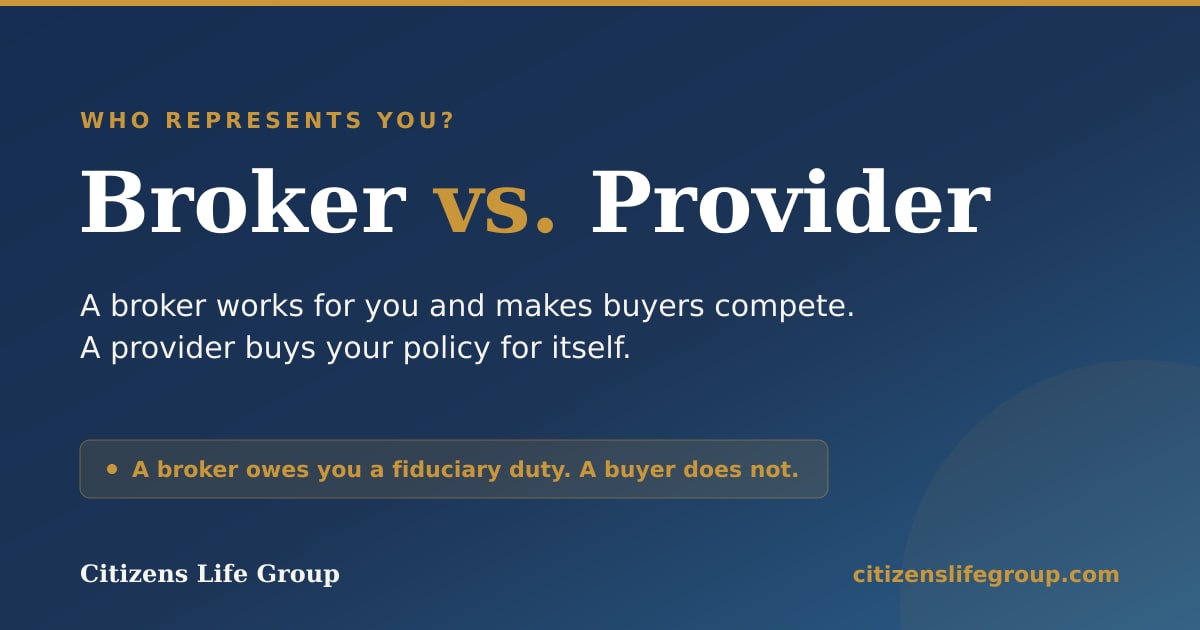
Under the laws of most states a life settlement broker owes the seller a fiduciary duty and a buyer does not. Comparison guides rarely say which is which.
ORLANDO, FL, UNITED STATES, July 27, 2026 /EINPresswire.com/ — Rankings of the best life settlement companies routinely place two different kinds of business in the same list. A life settlement broker represents the policy owner and shops the policy to competing buyers. A life settlement provider is the buyer, purchasing policies for investors or for its own account. Citizens Life Group, a licensed life settlement brokerage based in Orlando, has published an explainer on why the difference matters to the person selling the policy.
In its report on the life settlement market, the U.S. Government Accountability Office described the distinction plainly. “Life settlement brokers represent policy owners for a fee or commission and may solicit bids for policies from multiple life settlement providers with the goal of obtaining the best price,” the agency wrote. Of the other role, it wrote: “Life settlement providers buy life insurance policies for investors or for their own accounts.” The difference between a life settlement broker and a provider is which party the company works for.
That difference carries a legal consequence. According to the GAO, “state laws typically provide that regardless of the manner in which the broker is compensated, the broker owes a fiduciary duty to the policy owner.” The NCOIL Life Settlements Model Act, re-adopted in October 2024, states that a broker represents only the owner and owes that owner a fiduciary duty regardless of how the broker is compensated. Florida codifies the same duty at section 626.9916(5) of its statutes. Life settlements are legal nationwide, and 43 states plus Puerto Rico have enacted settlement-specific statutes, roughly 20 of them following the NCOIL model and about 12 following a model developed by the National Association of Insurance Commissioners. A buyer carries no comparable duty to the seller.
“Both kinds of company are licensed and both are legitimate, and the market does not function without buyers,” said Cole Hallman, Managing Partner of Citizens Life Group. “The problem is that a ranked list flattens them into one category. A seller who only ever sees a single offer has no way to know what the policy was worth.”
FINRA tells policy owners to establish who they are dealing with, asking whether a company is “a life settlement broker who represents you, or are they affiliated with a particular life settlement company,” and warning that an affiliated party “might only obtain an offer from that company, making it hard for you to know whether you’re being offered a competitive price.” Among the intermediary practices the GAO identified as abusive was “not seeking competitive bids for policies from potential buyers.”
Providers are licensed and regulated alongside brokers, and selling directly can be reasonable when a policy owner has already gathered competing offers. Absent that, in the GAO’s description, the broker’s role is to solicit bids from multiple providers with the goal of obtaining the best price for the owner.
The same regulators direct scrutiny at brokers as well. FINRA advises policy owners to “ask what bids were received and what steps the broker took to make sure you’re being offered the most competitive price available.” The GAO found that policy owners “could complete a life settlement without knowing how much they paid their brokers or whether they received a fair price for their policies, unless such information was provided voluntarily.”
“That second finding is about brokers, and it should be,” said Jeff Hallman, Managing Director at Citizens Life Group. “Ask what the offers were. Ask what the commission is. Get it in writing before you sign anything. A broker who will not answer those questions is not representing you.”
Licenses for brokers and providers alike can be verified through state insurance departments, and Florida licenses by name through the Florida Department of Financial Services.
About Citizens Life Group
Citizens Life Group is a licensed life settlement brokerage based in Orlando, Florida, that represents the policy seller and shops policies competitively to a network of institutional buyers. Its lead broker, Jeff Hallman, is a Florida licensed life agent (line 0215) with an appointed viatical settlement broker authority (line 0266). Citizens Life Group and its affiliated brokers are licensed in the states where they operate, and sellers can contact the firm to confirm availability in their state. There is no upfront cost to a seller, and any commission is paid from the settlement proceeds and disclosed in writing before the seller agrees to anything. More information is available at https://www.citizenslifegroup.com.
This release is educational and is not financial, tax, or legal advice. Fiduciary duties and licensing rules vary by state. Individual results vary, and not every policy qualifies or receives an offer.
Jeffrey Hallman
Citizens Life Group
+1 321-270-0279
email us here
Visit us on social media:
LinkedIn
Instagram
Facebook
YouTube
X
Life Settlement Broker vs. Provider: Who’s on Your Side?
Legal Disclaimer:
EIN Presswire provides this news content “as is” without warranty of any kind. We do not accept any responsibility or liability
for the accuracy, content, images, videos, licenses, completeness, legality, or reliability of the information contained in this
article. If you have any complaints or copyright issues related to this article, kindly contact the author above.

Media gallery